Understanding food | Changes of food farming system in South Korea under epidemic situation: consumers, food market and farmers
Since April 2022, South Korea has gradually liberalized various restrictions, looking forward to getting out of the shadow of the epidemic and returning to daily life. Since the outbreak of the COVID-19 epidemic in 2020, the Korean food farming system (referring to the connection system between consumers and farmers) has experienced unprecedented impact and crisis. Every chain in the system, from ordinary consumers, restaurants, food markets, supermarkets to farmers, is looking for new possibilities.
Spending more time at home not only drives online shopping and take-out, but also increases the time for family members to eat together, and promotes the popularity of family replacing meals. The fluctuation of food prices has forced consumers, including housewives, to find cheaper choices, which has made the food market see business opportunities. The auction of large-scale agricultural products wholesale market was transferred to the Internet, and small farmers also found a platform to connect directly with consumers.
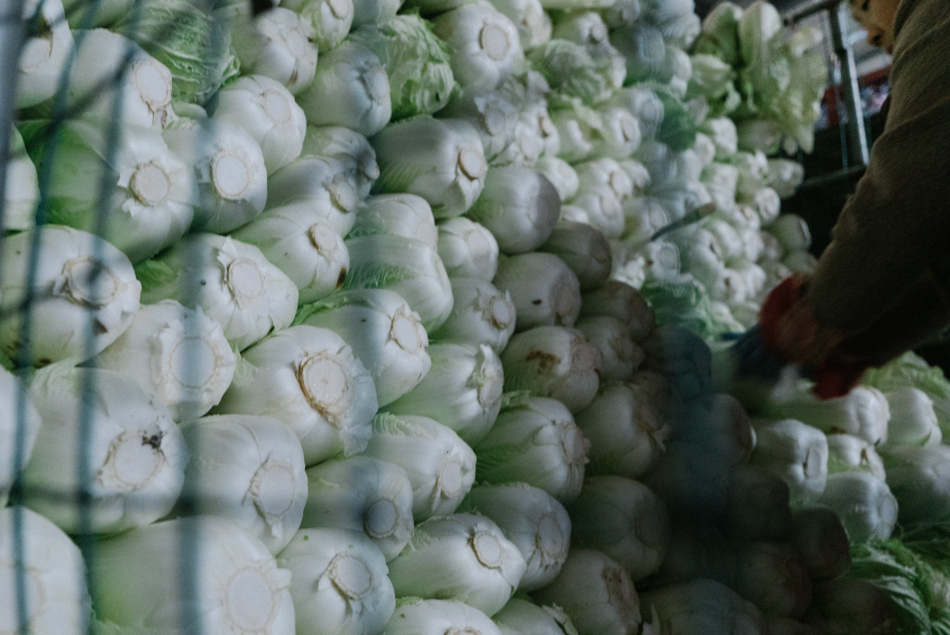
In 2017, Shanghai Jiangqiao Wholesale Market. A cabbage needs to go through several circulation and processing links from the field to the diners. The epidemic has changed these links, and people are also looking for new ways and opportunities. The Paper reporter Zhou Pinglang
Online shopping is growing rapidly.
On the evening of July 31st, 2021, after landing at Incheon International Airport in Seoul, we took a taxi to the reserved hotel. At the door, the ingredients such as mineral water, jiaozi and eggs that Korean friends helped to buy online were piled up.
After 14 days of home isolation, different friends helped us order ingredients and take-away food through different network platforms such as SSG, Coupang, and "the nation with delivery", which can be delivered accurately to what time. The delivery speed is very fast, usually delivered on the same day or early the next morning. The cold and fresh ingredients are stored in an incubator, delivered to the door at six in the morning, and still well preserved when the door is opened at eight or nine. Compared with the experience of online shopping in the United States, South Korea’s fresh ingredients online shopping is faster, better preserved, and cheaper, and there is no need to pay tips, basically exceeding a certain consumption quota, and the distribution is free.
In February 2020, after the outbreak of COVID-19 in South Korea, the government encouraged home office, postponed the new semester, and then switched to online classes. Busy Koreans spend more time at home, and online shopping is growing rapidly. In 2020, online shopping in Korea increased by 46% compared with the previous year, reaching a scale of 17 billion US dollars.
According to Statistics Korea’s online shopping tendency survey, compared with the previous year, in 2020, Koreans’ online shopping in food take-out and agricultural products, meat products and seafood grew the fastest, with growth rates of 78% and 67% respectively. Judging from the trend of online shopping in the past two years, even if the epidemic ends, online shopping will maintain a strong momentum. The rise of online shopping platforms has greatly squeezed the sales of offline stores. In response to the decline in sales, some large supermarkets and cooperative markets in South Korea launched delivery services, which rose against the trend in 2020, increasing by 7.8% and 16.1% respectively.
Family replaces the popularity of meals.
Our new home is located near the Xindaolin subway station in Seoul. There are many hospitals, department stores, cafes and convenience stores. Life is very convenient. There are more than 90 restaurants in a few blocks downstairs. After the isolation, we found that there were not many restaurants around, because the epidemic prevention level in Korea was the highest at that time, and the number of people dining out was limited to four at most, and they had to close after 9 pm. Almost all restaurants have transparent baffles installed on their tables to prevent droplet infection. When you enter the store, you need to take your temperature and register your residence or register by phone, so that you can track it. Under such strict dining requirements, not many people choose to eat in the hall. It was only after the epidemic prevention policy was released this spring that we realized how depressed the catering industry in this area was before when the surrounding restaurants returned to a state of buzzing and singing at midnight.
According to statistics, in 2017, 47% of Koreans often eat out, because the cost of ingredients is getting higher and higher, and because of the increasingly busy lifestyle and various restaurants everywhere. According to the data of Korea Rural Economic Research Institute, compared with the previous year, the rate of Koreans eating out decreased by 7.5% in 2020, and more than 80% people said in the questionnaire survey that they didn’t eat out for a whole year.The government used the "restaurant consumption revitalization" plan to stimulate consumption and provide emergency relief funds to those families directly or partially affected by the epidemic. Some local governments have also issued local currency to create "aseptic restaurants".However, concerns and fears about the spread of the epidemic and strict epidemic prevention measures have hit the catering service industry hard.
Under the epidemic situation, Koreans who are used to eating out can only eat at home. According to the annual questionnaire survey of the Korea Rural Economic Research Institute, in 2020, due to the epidemic, the proportion of families eating with their families was as high as 47.7%, which was only 4.4% in 2019. However, many "home meal replacement" foods were introduced in supermarkets, neighborhood markets and convenience stores, which greatly liberated busy workers and mothers.
My Korean friend Mae has two children, plus grandma and parents, and a family of seven lives under one roof for four generations. She and her husband are both full-time employees, so she often buys family meals from the supermarket. Bagged kelp beef soup is a must-have in the refrigerator at home, and you can eat it immediately after heating. What she likes best is the "peacock" cooking bag launched by her company New World and its largest supermarket brand Emart in South Korea in recent years. In addition to the army hot pot, pickled vegetable soup and miso soup that Koreans often eat, there are also Chinese miscellaneous sauce noodles, spicy beef noodles, Thai curry, Singapore fried noodles, Vietnamese rice noodles, Italian garlic shrimp with bread and other options. In each food box, the food, side dishes, spices and sauce packages are packed in vacuum. After opening, simply stir-fry and stew according to the recipe, and after 10-15 minutes, you can finish an exotic meal. Cook a delicious meal for the whole family early after work, and treat yourself by cooking at night after work. The price of ingredients boxes of different dishes varies, which is about 40-80 yuan RMB, which is much cheaper than eating out.
Although the family replacement meal market in South Korea developed around 2016, its sales reached a new high during the epidemic. In 2020, take-away food and families replaced meal consumption, an increase of 77.5% compared with 2019. Among the "Peacock" cooking packages, an army hot pot launched in 2020 was very popular and sold more than 180,000 copies. The Korea Rural Economic Research Institute predicts that by 2024, this market will reach 646 million US dollars.
Inflation is serious, and the number of people applying for assistance is increasing.
After home isolation, I went to the supermarket to buy food and found that the fruit in Seoul was very expensive. Take the seasonal fruit watermelon in summer as an example. The price of a medium-sized watermelon is about 100 RMB, which is three times that of Florida watermelon in the same season. Other fruits, such as grapes, apples and even tomatoes, are one to two times more expensive than those in the United States.
Later, I met some Korean friends in China who lived in Seoul for seven or eight years. One of the housewives, Jin Kunjie, said that the fruit in Seoul was very expensive. In the past three years, the price of fruits and vegetables has become more and more expensive. Take Apple as an example. In 2019, it was about 5.25 RMB each, and this year it rose directly to about one RMB in 9 yuan. Korean friends around us, including children, eat fruits cleanly and rarely waste them.
Jin Yinghui is also a Korean. He has worked in the community retail store "My Market" in Xindaolin for 11 years and has a deep understanding of the fluctuation of vegetable prices in the three years of the epidemic. He remembers that Chinese cabbage, the most commonly eaten by Koreans, was about a bag (3 pieces) of RMB in 30 yuan before the epidemic. At the end of last year, it once rose to about 70 yuan, and this spring it fell back to about 47 yuan. Before the epidemic, the purchase price of eggs was about 30 in 20 yuan. This spring, the purchase price rose by about 10 yuan RMB. My friend Yu Zhengji remembers that the price of eggs soared to about 30 in 50 yuan last year. She asked the vendors who frequented the community vegetable market, only to know that the price of chicken feed increased, and even the prices of chicken and eggs increased.
Since the third quarter of 2020, the prices of agricultural and fishery products have soared in South Korea, an increase of about 18% compared with the previous two quarters. The most direct cause is the flood caused by rare climate change, but the impact of the epidemic can not be ignored.
South Korea’s agriculture has long relied on foreign workers, and the COVID-19 epidemic has prevented foreign workers from going abroad, resulting in a large labor shortage. South Korea’s Ministry of Employment and Labor said it would allocate 9,400 seasonal workers to agriculture and fisheries, but only 1,384 foreign workers finally entered the country smoothly. Farmers in South Korea had to hire local workers at high prices, which directly pushed up the prices of agricultural and fishery products.
Under the epidemic situation, food distribution channels have also undergone drastic changes, resulting in the waste of many perishable foods. The prices of major international cereals, such as corn, soybeans and wheat, also rose rapidly after the third quarter of 2020.
In 2021, although the epidemic situation in South Korea was slightly stable, prices continued to rise, causing overall inflation. In the second quarter of 2021, the supply of agricultural products was in short supply during the outbreak of avian influenza, which greatly pushed up the prices of agricultural products. The Korea Herald reported that in April, the prices of agricultural products, meat products and fishery products rose by 17.9%, and the price of onions alone rose by 270%.
At one time, Seoul people could not afford to eat onions. Jin Kunjie remembers that before the epidemic, a handful of shallots cost only seven or eight yuan. Last year, the price rose to RMB in 24 yuan for a long time, and sometimes it was even impossible to buy it. At one time, onions could only be used instead. Koreans like to put a lot of onions in their diet, but at that time they went to the restaurant to eat noodle soup, and only two or three green chopped onions floated sporadically on it. Last summer, she and her family traveled to Yuanzhou, gangwon, and ate beef soup in a small shop in the country. When they saw the green chopped green onion floating on the surface, they were in tears. Just ask the restaurant owner to know that South Korea imports a lot of vegetables from China every summer, and shallots are among them. The epidemic affects the transnational supply chain, and restaurants and supermarkets in cities will naturally raise prices if they can’t buy shallots. The restaurants in the countryside grow their own vegetables, and the shallots are put in handfuls.
According to the report of the Bank of Korea, the inflation rate has been breaking records since the second half of 2021. By January 2022, the inflation rate of consumer goods was close to the highest point in a decade. In the second half of 2021, South Korea’s price increase rate ranked third among OECD countries, only after Turkey and Australia. The prices of Lamian Noodles, milk, other foods and beverages continue to rise because of the impact on the supply chain. In the third quarter of 2021, it increased by 2.6% compared with 2020, when the price rose sharply.
Kyochon F&B, the number one fried chicken distributor in South Korea, raised the price of all fried chicken by 8.1% in November 2021. This is the first price increase in seven years. Quchuntang, a rice wine company that Koreans like, has also increased the price of rice wine by 25% due to the increase in international grain prices. Kang Hee-won, the sales manager of Korea’s largest meat wholesale company, mentioned in an interview that the wholesale price of beef ribs was about 20,000 won a catty at the beginning of 2021, and it rose to 30,000 won in November, an increase of 50%.
"As the labor market is unstable, rising food prices will deal a heavy blow to the lower classes, because most of them lost their jobs during the pandemic."Jin Shiwan, a professor at Ewha Women’s University, said.
For more than two years before January 2020, the average number of families receiving livelihood benefit in South Korea was only 1,500 per month, but from February 2020, the number of families receiving assistance rose to 6,000. In August 2021, the government decided to give about 88% of the people about 250,000 won (about 1,314 yuan) in aid.
The food market has increased against the trend.
In the past three years, housewives have been particularly sensitive to rising prices and are looking for cheaper alternatives everywhere.
By studying the consumption data of residents’ credit cards and debit cards, Korean scholars found that under the epidemic situation, consumers who chose to buy ingredients in retail stores and convenience stores near their homes increased significantly, while at the same time, the number of people shopping in department stores and supermarkets decreased significantly.
Jin Kunjie found that in Yongdengpu District, where she lives, the food market has opened more and more in the past two years. In the so-called food market, more than 90% of the goods are vegetables and fruits. Originally, it was a supermarket that directly provided food to restaurants and small restaurants, but in recent years it attracted many ordinary consumers.
Large supermarkets have to be closed for two days every month. Originally, it was to provide living space for traditional markets and community retail stores, but the food market has become the first choice for community residents to buy food because of its all-day and lower prices. "The same plate of 30 eggs costs more than 50 RMB in large supermarkets and sells 30 or 40 pieces in neighborhood stores or food markets. Housewives naturally know how to choose. " Jin Kunjie said.
According to a report by the Korea Ministry of Industry, Trade and Resources, in 2020, due to the epidemic, the sales of large supermarkets and enterprise supermarkets decreased by 3% and 3.8% respectively, while the sales of Segyero market, the largest food market in China, increased by 20%, and Jangbogo, another food market, also increased by 17%.
Under the epidemic, these food markets have opened one after another, and because the store area does not exceed 3,000 square meters, they are recognized as small and medium-sized enterprises, and they can apply for emergency relief funds from the government. For example, after the closure of Homeplus Dongjinhai branch in Sanfangdong, Jinhai City, Gyeongsangnam-do, it was replaced by the food market named "First Market". Due to the high rent, Lotte Supermarket Jiuli Store opened a new store at the same address in June 2020 after winning the bid with an annual rent of 3.3 billion won (about 17.386 million RMB) from the food market Elmateu.
疫情之前,食材市场就已快速发展。根据韩国流通协会的数据,2019年食材市场50-100亿韩元规模的店铺,较2014年增长了72.6%,销售额也增长了36.5%。截至2019年,销售额超过100亿韩元的食材市场仅占社区超市、便利店、大型超市、百货商店和综合商场等线下零售商总数的0.5%,销售额却占到市场总额的 24.1%。疫情只是把因收入减少而消费降级的人群,更多集中到食材市场里。
食材市场利用政策空隙,在大型超市、综合型小超市和传统市场之间打开了一条野蛮生长的道路,引起了韩国超市合作协会、全国商人联合会等许多成员的激烈反对,要求它们像大型超市一样每月固定时间关闭,不能全天候营业。但目前没有针对食材市场的严格政策规范。
Connect consumers and farmers directly.
Farmers in South Korea have established many associations similar to vegetable alliances according to regions to ensure a guaranteed price for agricultural products. Farmers sell their output through various large and medium-sized wholesale markets for agricultural products and fishery products. Vendors, including supermarket chains, traditional market stalls, neighborhood shops and even middle sellers, must go to the wholesale market to bid for the agricultural products of the day, so the prices of agricultural products fluctuate every day. After the auction, the buyer can pay the same day to return to his store with fresh ingredients such as meat, fish, eggs, milk, vegetables and fruits, or resell them to the next level of sales channels.
In June, 2020, the Ministry of Agriculture, Animal Products and Food of Korea, the Agricultural Association and the Korea Rural Economic Research Institute jointly developed an online agricultural product trading system, which moved the auction trading in major wholesale markets online. A total of 2,200 wholesalers participated in the auction, and many distributors including Emart participated in the auction. At first, the auction varieties were limited to onions, and then other varieties of vegetables and fruits were launched one after another.
There are two auction times every day, five days a week, except weekends. In this online trading system, the highest bidder can buy agricultural products directly from farmers. After the payment is successful, the agricultural products will be transported directly from the farm to the designated place the next day without going through the wholesale market. The online trading system charges 3% listing fee, which is much lower than 4-7% in the offline wholesale market. And greatly saves the time and transportation cost of farmers, distributors and wholesale markets.
Jung Young-jae, a senior manager of Hanyang Agricultural Association, said that after simplifying the distribution costs, the prices of agricultural products can also be reduced by 3-15%, farmers can sell better prices, and consumers can also buy vegetables with good quality and low price. It can be said that it is another convenience and welfare brought by non-contact shopping under the epidemic situation.
Consumers have also found another way to buy agricultural and fishery products directly from farmers, bypassing wholesale markets and retailers. Korean friend Gao Huiying is a senior housewife, and with the baby in her belly, she has four children at home. Growing children eat a lot, and the consumption of ingredients at home is large and fast. Naver’s APP Band is the most popular mobile social media in Korea, with four or five million more users than Instagram and Facebook. Huiying found an online shopping platform named "Nongle" on Band. She bought fresh agricultural, animal husbandry and fishery products directly from farmers, and bought a box of vegetables, fish or meat at a time, but she also had to bear the transportation expenses herself, but it was cheaper and fresher than going to the market. For example, if you buy a box of hairtail for about 50,000 won (about 158 yuan), the same product will cost more than 10,000 won in the supermarket.
At present, Nongle has nearly 1.04 million users, and more than 100,000 people visit it every day. Since its establishment in 2012, it has mainly relied on word-of-mouth promotion by housewives and other consumers. At first, it was founded by young people who wanted to help their parents sell agricultural products. The founder’s parents’ farm was only 200 ping (about 661 square meters), and the variety of products was small, so it was difficult to enter large shopping malls, and it was difficult to enter the wholesale market to participate in bidding. When the harvest was good, they could only be sold in stalls. In order to help many small farmers with similar difficulties, the founders used Naver Café ("Naver Coffee") platform, which allowed users to set up online communities directly, to start the "Country of Direct Trading of Agricultural Products", and later renamed it "Nongle". Farmers who settle in can have a sales channel only by paying 100,000 to 200,000 won (about 527 yuan to 1,054 yuan) a year, and the cost is far cheaper than entering large-scale businesses.
Nongle provides the most elementary technical support. Farmers send simple photos on it, and consumers can chat with producers directly in the message board and ask for details and prices. After the transaction is concluded, the farmer will deliver the goods directly to the consumers. Consumers supervise farmers through additional comments, and farmers have the obligation to refund if the products are defective. For farmers who operate in bad faith, the management team of Nongle can vote by members according to the norms jointly formulated and observed, and kick farmers off the platform.
The epidemic for three years has had a great impact on all stakeholders under the food-farming system. Farmers, middlemen, various types of supermarkets, markets, restaurants and consumers are all trying to return to their daily lives. The government has also introduced many assistance measures.
In 2020, due to the delay in the start of school, farmers who signed the supply contract school meal plan could not distribute the ingredients, and the government encouraged supermarkets and government-related distributors to buy them. The Korean Pork Association also bought some ingredients, and people can receive free water celery while buying meat.
Farmers who need to be isolated at home because of infection can apply for low-interest loans, totaling 48.8 million US dollars. Affected flower farmers can also apply for low-interest loans. The government also encourages restaurants to buy ingredients from local farmers, and provides low-interest loans totaling $16.3 million for restaurants that buy local ingredients.
To understand food is to understand the connection between man and the earth. The column "Understanding Food" was planned and written by Good Food Fund of China Green Hair Association. This article is a Korean reference, translated and arranged by Huang Qingming, a doctoral candidate at the University of Florida and a Junior Fellow at Seoul National University)
References:
English reference materials:
1.Hanghun Jo, Eunha Shin and Heungsoon Kim, Changes in Consumer Behaviour in the Post-COVID-19 Era in Seoul, South Korea, https://www.mdpi.com/journal/sustainability, 2021.
2.Alison Blay-Palmer , Guido Santini ,Jess Halliday ,Roman Malec , Joy Carey , Léo Keller , Jia Ni ,Makiko Taguchi nd René van Veenhuizen , City Region Food Systems: Building Resilience to COVID-19 and Other Shocks, https://www.mdpi.com/journal/sustainability, 2021.
3.USDA Foreign Agricultural Service Voluntary Report , COVID-19 Impact on Food Market Trends in Korea, April 29, 2021.
4.USDA Foreign Agricultural Service Voluntary Report , Additional Impact on Korean Agriculture and Food Situation, March 25,2020.
5.Seoki Lee and Sunny Ham ,Food service industry in the era of COVID-19: trends and research implications,Nutrition Research and Practice,2021.
6.Shenggen Fan, Paul Teng, Ping Chew, Geoffry Smith, Les Copeland , Food system resilience and COVID-19 – Lessons from the Asian experience, Global Food Sercurity ,2021.
7.Jani Toivanen,MARKET ANALYSIS:SOUTH KOREA,Bussiness Finland,https://www.businessfinland.fi/globalassets/food/fff_coachingday_korea_presentation_final_jt.pdf
8.Chang Dong-woo,S. Korean farmers struggle from labor shortage as pandemic disrupts migrant work system, Yonhap News Agency,https://en.yna.co.kr/view/AEN20211015006600315,2021
9.Lim Jang-won ,Making favorite restaurant dishes at home:As pandemic keeps people from dining out, restaurants turn to meal kits, The Korea Herald,http://www.koreaherald.com/view.php? ud=20201209000863,2020.
10.Jung Hyuk-hoon and Minu Kim,Korea’s online agricultural exchange saves time and money for producers, retailers, https://pulsenews.co.kr/view.php? year=2020&no=586553,2020.06.08
11. Choi Jae-hee,S. Korea’s food prices increase to third highest among OECD states,The Korea Herald , http://www.koreaherald.com/view.php? ud=20210808000189,2021
12.Kang Jae-eun,Food prices rise from pandemic, set to hit lower earners hard,The Korea Herald ,http://www.koreaherald.com/view.php? ud=20211122000812,2021
13.South Korea’s inflation jumped 3.6% in January as fuel and food prices surged,REUTERS, https://www.cnbc.com/2022/02/04/south-koreas-inflation-jumped-3point6percent-in-january-as-fuel-food-prices-surged.html,2022
14.Sanhyo Kim and Seongyong Shin,Post-COVID-19 Era, Changes and Outlook in Korea’s Agrifood Industry, FFTC Agricultural Policy Platform,https://ap.fftc.org.tw/article/2898,2021
15.Oh Dae-seok and Cho Jeehyun,Naver’s Band tops Korea’s social media markethttps://m.pulsenews.co.kr/view.php? year=2020&no=65394,2020
Korean reference materials:
1.전통시장이 아닌 쿠팡, 식자재마트 도운 대형마트 규제
https://www.seoul.co.kr/news/newsView.php? id=20220519500036
2."소비자 후기가 핵심이죠".. 영세 농어민과 소비자 잇는 농라
https://www.straightnews.co.kr/news/articleView.html? idxno=210977
3.홈플러스·롯데마트 사라진 자리 채우는 ‘식자재마트’
https://news.nate.com/view/20211214n02209
4.네이버 농식품 중개몰 ‘농라카페’
https://www.withbuyer.com/news/articleView.html? idxno=21639
5.산지직송 ‘B급 감성’ 농라카페를 아십니까
https://www.hankyung.com/economy/article/2021051987721
6.코로나19 속 식자재마트 출점·영업 규제 논란증폭
https://www.foodbank.co.kr/news/articleView.html? idxno=60425