Relatives of the "black boss" were dissatisfied with the verdict and made a scene. The court insulted the judge and threatened to kill and retaliate.
CCTV News:The court is a place to show the dignity of the national legal system and judicial authority, and anyone should abide by the court discipline. However, in the process of sentencing a criminal case in Jiaxing, Zhejiang, three observers vented their dissatisfaction because they were dissatisfied with the court’s decision, insulted and threatened judicial staff in court, and tried to attack the court.
On December 25, 2018, what kind of case was pronounced by the court, what happened, and why did several observers ignore the law and make a scene in court?
Judge Lan Gui of Jiashan County People’s Court, Jiaxing City:We tried a triad-related case in which 10 people, including the defendant Zhang, were suspected of organizing leaders to participate in underworld organizations, forcing transactions, causing trouble, intentional injury and so on.
The situation in the public gallery of the black case was sudden.
It was found through trial by the court that since April 2015, in order to monopolize the local transportation market of construction waste and bulk building materials, the defendant Zhang and others have recruited social personnel, intercepted, intimidated, smashed, harassed, clamored for other transporters and construction sites, gathered people to create momentum, forced transactions, seized the market, and raised the price of the transportation market, forming an underworld organization with a large number of people, fixed backbone members and distinct levels.
Relying on the backing of violence and the reputation of the organization, the defendant has repeatedly carried out illegal and criminal activities such as forced trading and trouble-making, intervened in civil disputes and oppressed the masses, causing psychological panic to the victims and the people concerned, disrupting the order of the local construction waste and bulk building materials transportation market, undermining social security and business environment, and causing great social impact in the local area.
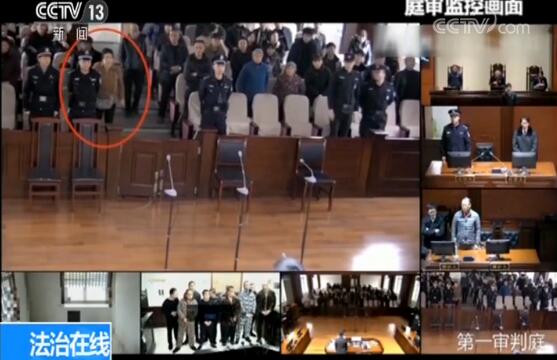
In 2018, this case was heard by the court twice and was pronounced in the first instance on December 25.
Although the defendant was not present, this organized crime case involving ten people attracted many people to attend. On that day, most of the audience were relatives of the defendant. According to the memory of the bailiff on duty, after the trial at 3 pm, although there were occasional discussions and exchanges, the overall order was still good.
Halfway through the verdict, a middle-aged woman sitting in the second row of the gallery, Tang, a relative of the defendant Zhang, began to look back and talk to the audience in the back row. Her voice and actions attracted many people’s attention. After being reminded by the bailiff in the front row, Tang was a little quiet. However, when the presiding judge read the sentence, she couldn’t sit still again.
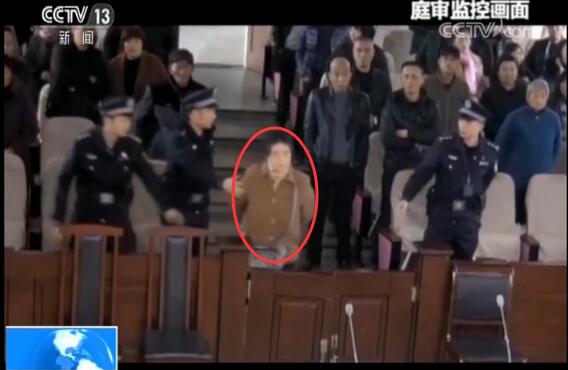
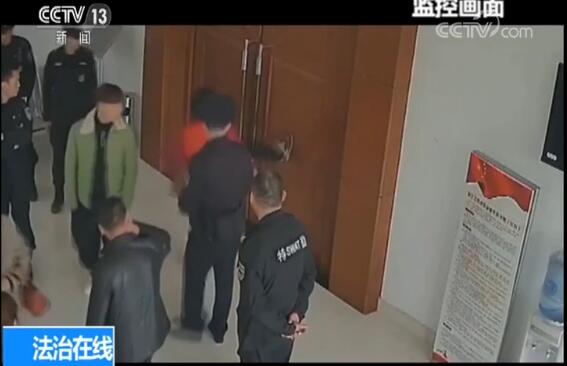
Tang began to move to the center of the aisle, squeezed past and tried to stand in front of the first row of bailiffs. After being stopped by bailiffs, she raised her hand and shouted.
The presiding judge temporarily stopped reading and waited for the bailiff to maintain order, but Tang’s shouting voice and movements became louder and louder, and other people in the gallery also crowded into the aisle.
Bailiff Wu Yuting:Tang started to make noise and began to insult. At first, he was threatening, that is, swearing. After he ran away, he tried to attack the court. He tried to climb the guardrail of the court several times, so he was directly pulled by the three bailiffs.
Under the influence of Tang, some observers also joined the noisy ranks. As seen in the picture, many observers were blocked in the middle of the aisle. Under the obstruction and control of the bailiff, Tang returned to the second row and still shouted at the trial area with his finger.
These observers gradually moved closer to the front row area, trying to hear the verdict clearly. The bailiff stood in a row in front of Tang and others to prevent someone from continuing to attack the trial area.
The verdict is over, and the detention in the court is now amazing.
Disturbed by these bystanders, the sentencing, which was not complicated, could not be carried out smoothly and the sentencing process was interrupted. After the verdict, they remained in court and tried to break into the court office area. Why did Tang and several other observers do this, and what kind of relationship did they have with the case?
As seen in the picture, after the presiding judge, judges, prosecutors and defense lawyers left, Tang was still standing in the middle of the aisle in the gallery, and he was emotional. The observers have left the court one after another, and when the bailiff didn’t pay attention, she made another amazing move.
Bailiff Wu Yuting:She was running around, and after she ran away, she carried a stool inside and pushed it out directly.
The bailiff recalled that at that time, they had been discouraging, but Tang continued to pick up the stool. After being stopped, he vigorously shook the facilities in the court and pushed down the seats placed in the court for the second time.
After repeated persuasion, several observers who were stranded in the court left one after another. Tang suddenly turned and rushed into the court and continued to shout loudly. After being taken away from the court, she kicked the door again. Just next to this door, the signboard of "Zhejiang Court Trial Discipline Style Code" is placed in an obvious position.
He was detained on suspicion of disturbing court order.
After the incident, the local public security organ launched a case investigation, and on December 29th, 2018, Tang and Zhang Qiu, who were involved in disturbing the court, were criminally detained on suspicion of "disturbing the court order", and another suspect, Zhang Jianmou, was released on bail pending trial.
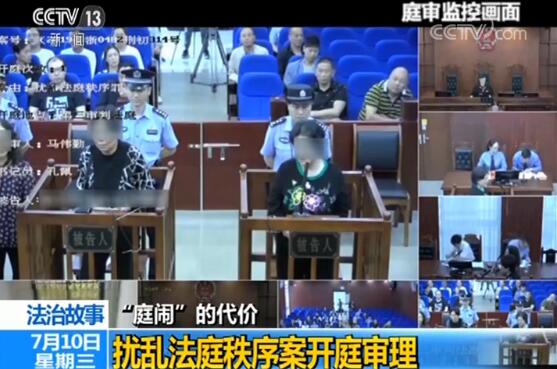
Police investigation found that all three suspects were relatives of the defendant Zhang in the triad-related case pronounced on the day of the crime. Among them, the suspect Tang is Zhang’s cousin. She confessed that Zhang had borrowed more than one million yuan from her before he was arrested for being involved in black activities. When she heard the presiding judge say in court that all Zhang’s property would be confiscated, she was in a hurry and shouted at the judge. The other two suspects are Zhang’s immediate sister and cousin. They claimed that because they saw Tang’s actions, they thought that their elderly father needed care and thought that the sentence given to Zhang was too long.
In fact, Zhang and other defendants continued to appeal to Jiaxing Intermediate People’s Court after the verdict was pronounced in the first instance. In April 2019, the court of second instance rejected Zhang and others’ appeal and upheld the original judgment. Zhang was sentenced to 12 years in prison, deprived of his political rights for two years, confiscated all his personal property and fined 200,000 yuan for organizing and leading underworld organizations, forcing transactions, and stirring up trouble.
The case of disturbing court order was heard in court.
Tang and other three people expressed their dissatisfaction with the verdict by making a scene in court. Not only did they not have any expected effect on Zhang’s triad-related case, but they made themselves violate the criminal law, and their behavior constituted a crime of disturbing court order.
The lady standing in the dock crying quietly is Tang, who made a scene in court more than five months ago. Next to her are the defendant Zhang Qiu and Zhang, who had been released on bail pending trial. This familiar recording of court discipline was played and the trial began.
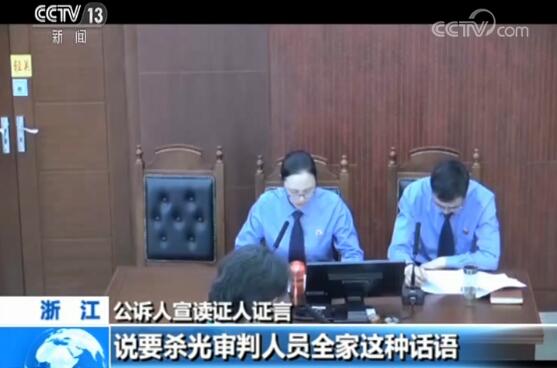
The public prosecutor showed the witness testimony of several observers on the day of the incident, proving that the defendant Tang began to abuse loudly after hearing the specific sentence read by the presiding judge and was not controlled by the bailiff.
The prosecutor read the witness testimony:When Tang broke away from the control of the bailiff, he pointed his finger at the presiding judge and prosecutor in the trial area, cursing all the local dialects. Suddenly, the scene got out of control and others began to get out of their seats.
The testimony of the presiding judge, judges, prosecutors, bailiffs and others on the day of sentencing proves that the actions of the defendant Tang and others once led to the interruption of sentencing.
Prosecutor:After the reading was completed, I saw that there were still people in the gallery who continued to make trouble, and the bailiff was also stopping it. The presiding judge has been working in the court for 30 years, and it is the first time that he has abused the judge in court. Later, in the briefing of the internal meeting of the unit, he also obtained threats and intimidation from the other party’s abuse in court, and said that he would kill all the judges’ families, and the personal of judicial personnel and family members had been threatened.
The public prosecution agency also showed the surveillance video of the west gate of the court on the day of the incident: at 15:56 pm, the observers walked out of the court building and left the court one after another, while the defendant Tang tried to go inside the court and finally left under the obstruction of the police.
At 16 o’clock in the afternoon, the monitoring of the east gate of the court showed that the defendant Tang rushed to the door and grabbed the court door with one hand to stop a police car from leaving. Then she called other relatives and stood in a row to block the exit.



However, the court pronounced the sentence in a video session on the same day, so the defendant was still in the detention center. Subsequently, the court staff allowed Tang to check in the car and found that there was no one. Tang returned to the door. Instead of leaving, she continued to guard the door, propping her back against the door.
Three minutes later, seeing a car coming in, Tang continued to block the car and leaned against the hood of the vehicle.
Stopped by the iron gate, Tang continued to abuse loudly and spit at the court staff to vent his emotions. After some uproar, Tang and other talents left the court one after another.
In the trial, all three recognized the facts of the crime.
In the court, three defendants, including Tang, recognized the criminal facts accused by the public prosecution agency. The public prosecutor believes that Tang plays a major role in the joint crime and is the principal offender, so he should be given a heavier punishment. However, Tang knows that his actions disturb the court order and still carries them out, which is subjective and intentional.
It is completely different from the arrogant attitude of making a scene in court and blocking the door. During the trial, Tang has been crying and expressed his regret.
Tang:Presiding judge, I was wrong, I was wrong.
Zhang Qiu:We were wrong. We won’t do this next time. Please forgive us and give us a chance.
At the same time, Tang’s defender believes that Tang did not lead or collude with other defendants to commit acts of disturbing order. The three were not joint criminals, and Tang was not the principal offender. Tang, on the other hand, has a low level of education and lacks legal common sense, because he made this behavior on the spur of the moment.
Regarding whether the three defendants proposed by the defender were joint crimes in the whole incident, the court held that before the trial, several defendants did not plan in advance, but the defendant Tang’s actions triggered a series of subsequent behaviors.
At the same time, the judge believes that Tang and others gathered to make trouble in the court, which not only led to the forced interruption of the verdict, but also caused the three people to insult and curse loudly in the local dialect, which greatly damaged the personality and reputation of the judicial staff who normally performed their official duties and brought great psychological pressure to the case-handling judge.
Ma Weiqin, Judge of pinghu city People’s Court:From this case, we can see that our law enforcement judge was afraid to go to work after disturbing the court order. It was a period of time when her family took her to work, so it was enough to show the personal influence of this behavior of disturbing the court order.
Three people were sentenced to different sentences in court.
On May 29, 2019, the court made a judgment in court: all three defendants were guilty of disturbing court order, among which the defendant Tang was sentenced to one year and two months in prison, the defendant Zhang Qiu was sentenced to ten months in prison, and the defendant Zhang was sentenced to nine months in prison with a suspended sentence of one year and three months.
Article 199 of China’s Criminal Procedure Law stipulates that in the course of court trial, the presiding judge shall give a warning to stop the participants or observers who violate the court order. Those who do not listen to stop can be forcibly taken out of the court; If the circumstances are serious, a fine of less than 1,000 yuan or detention of less than 15 days shall be imposed.
Those who gather people to make trouble, attack the court or insult, slander, threaten or beat judicial personnel or participants in litigation, thus seriously disrupting the court order and constituting a crime, shall be investigated for criminal responsibility according to law.
According to Article 309 of the Criminal Law of People’s Republic of China (PRC), anyone who disturbs the court order in any of the following circumstances shall be sentenced to fixed-term imprisonment of not more than three years, criminal detention, public surveillance or a fine:
(1) Gathering people to make trouble and attack the court;
(2) Beating judicial personnel or participants in litigation;
(3) Insulting, slandering, threatening judicial personnel or participants in litigation, refusing to listen to the court to stop them, and seriously disturbing the court order;
(4) Disrupting court facilities, robbing or destroying litigation documents and evidence, and other acts that disturb court order, if the circumstances are serious.
Legal experts believe that the three defendants in this case did not listen to stop, gathered people to make trouble, insulted, slandered and threatened judicial staff, which was essentially an act of challenging legal authority.
In this case, the defendant claimed to make trouble in court because he was dissatisfied with the verdict. Experts believe that his demands should be expressed in a rational way, rather than venting his emotions by gathering people to make trouble in court.