The Yellow River is becoming a reality.
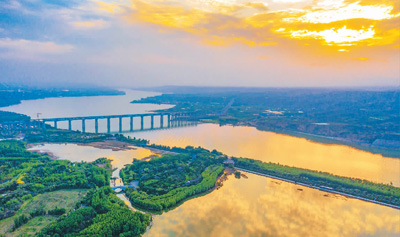
On April 17, the Yellow River Wetland in Sanmenxia, Henan Province at sunset, the water surface was clear, just like a mirror on the earth. Photo by Du Jie (People’s Vision)
It’s really a wonder: the Yellow River water has become clear!
Since mid-May, the hukou of the Yellow River, which is usually full of turbid waves, has turned into a clear waterfall from time to time, rushing down a steep cliff of more than 20 meters. Along the provinces (regions) of the Yellow River, the news that the Yellow River has become clear is constantly coming: from Hekou Town, Tuoketuo County, Inner Mongolia to Taohuayu, Zhengzhou, Henan Province, more than 1,200 kilometers of the middle reaches of the Yellow River, there are many scenes of "one river flowing eastward".
According to geological expert Li Erong’s textual research, there are only 43 times of "Huang Heqing" recorded in history, and the longest time is 1727, which lasted for more than 20 days. Today’s "Huang Heqing" involves a wide range of river basins and lasts for a long time, which is rare in history.
The "yellow" of the Yellow River is actually sediment. Ancient books contain: "The Yellow River fights water, and mud ranks seventh." According to the analysis of modern measured data, the average annual sediment transport in the main stream of the Yellow River is 1.6 billion tons, and the sediment concentration is 35 kilograms per cubic meter, which is the highest in the world.
Where does the Yellow River sediment come from? 90% come from the Loess Plateau. The soil here is loose and easy to corrode and disperse. Whenever the rainstorm washes away, it loses a lot of soil and water and rushes into the Yellow River. The folk song "The next rain, peeling off a layer of skin, exhausted and hungry" is a portrayal of the barren and desolate loess plateau.
"Long-term soil erosion has caused many places to become stony and sandy, with almost no soil, and the survival rate of trees is very low, which seriously affects the production and life of local people." Hao Yunfeng, deputy director of Yichuan County Forestry Bureau, Yan ‘an City, Shaanxi Province, said.
The lost sediment makes the economic and social development of the Yellow River basin lag behind for a long time — — Five of the 14 concentrated contiguous destitute areas in China involve the Yellow River Basin.
The fundamental change took place after the founding of New China. The Yellow River has been systematically treated for the first time, and "sand retreating from the river to clear it" is becoming a reality: according to estimates, in the past 20 years, the middle reaches of the Yellow River have intercepted and reduced more than 400 million tons of yellow sediment every year on average.
How did New China do it?
— — Returning farmland to forests, planting trees and realizing "green into sand and clear water"
Ziwuling, located in the hinterland of the Loess Plateau, is an ecological barrier in Longdong area and is regarded as a sample for observing soil and water conservation in the Yellow River Basin. However, due to excessive logging, industrial development and other factors, Ziwuling lost 4,800 square kilometers of natural forests during the 40 years since the founding of New China.
"When I was 11 years old, my father took me into the forest area for the first time. At that time, I felt that the trees were sparse, dusty and rainy." Lu Yanjing, Party Secretary of Songzuipu Forest Farm in Ziwuling Nature Reserve, Gansu Province, is a second-generation forest ranger. In his memory, since the implementation of the "Natural Forest Protection Project" in 1998, trees have been planted on a large scale in the forest area. At present, 60% of the 3.21 million mu of trees managed by the forest farm in the reserve are artificial forests.
In 2013, Qingyang City, Gansu Province set a new goal: 1 million mu of afforestation every year, and in seven years, "recreate a Ziwuling!" Today, this goal has been basically achieved.
Ordos City, Inner Mongolia Autonomous Region is located in the upper and middle reaches of the Yellow River. According to the remote sensing survey in 1995, 80% of the city is suffering from soil erosion, and about 150 million tons of sediment flows into the Yellow River every year.
The situation is grim, and the city has begun to return farmland to forests and grazing land on a large scale. Today, Ordos City has not only reduced the area of soil erosion by more than 50% compared with 1995, but also achieved a forest coverage rate of nearly 30%, making it a national forest city.
— — Scientific management, multi-point policy, to achieve "blocking mud and collecting grain."
Soil erosion is easy to destroy but difficult to control — — It takes 120 to 400 years to form 1 cm of soil, while it often takes only one year to lose 1 cm of topsoil. To preserve soil and water, we must follow the laws of nature and scientific methods.
Suide Soil and Water Conservation Station of the Yellow River Conservancy Commission was founded in 1952, and carried out silt dam test and vegetation research in Shaanxi.
Vegetation research is an extremely complicated work. Xindiangou Soil and Water Conservation Demonstration Park, which belongs to Suide Soil and Water Conservation Station, has been cultivating tree species for the soil on both sides of the Yellow River since 1953. Through the introduction of hundreds of fruit trees, the research and popularization of acacia slope protection forest and other tree species have made important contributions to greening barren hills and sandy land and planting cash crops.
Over the past decades, more than 59,000 warping dams have been built on the Loess Plateau.
"The Loess Plateau has hundreds of years of development history of warping dam construction, but the real rapid development is after the founding of New China." Bai Pingliang, director of Xindian test site, who has worked in soil and water conservation station for more than 30 years, said.
The construction of warping dams has greatly reduced the amount of sediment flowing into the Yellow River. Take Wuding River, the main tributary of the Yellow River, as an example, from 1971— 1980 compared with 1952— In 1960, the sediment discharge decreased by 62.4%.
Afforestation and grass planting, returning farmland to forests, and closed management … … With the implementation of various measures, the vegetation coverage rate on the Loess Plateau has increased from 32% in 1999 to 63% in 2018.
— — Ecological poverty alleviation turns harm into benefit, and one battlefield wins two battles.
Since 2000, Shanxi Province has been experimenting with returning farmland to forests in the Yellow River Basin, which has been combined with poverty alleviation through cooperative afforestation and management of poor people.
Wang Mingzhen and his wife, poor households in Hamashen Village, Jiewangshi Township, Lan County, Lvliang, are the beneficiaries of this policy. In the new round of 115,000 mu of returning farmland to forest project in Lan County, the couple joined the local cooperative and engaged in the work of tending, planting, weeding and spraying seabuckthorn seedlings, with an annual income of about 35,000 yuan.
As of 2018, Shanxi has completed a total of 27.303 million mu of returning farmland to forests, benefiting 1.53 million households with 5.47 million people.
September 2019 is a day worth remembering in the history of Yellow River management. General Secretary of the Supreme Leader presided over the symposium on ecological protection and high-quality development of the Yellow River Basin. Since then, the ecological protection and high-quality development of the Yellow River Basin have become a major national strategy, and a new blueprint for the management of the Yellow River has been spread out:
In the upper reaches, we will focus on the water conservation areas in the upper reaches of the Three Rivers, Qilian Mountains and Gannan Yellow River, and promote the implementation of a number of major ecological protection, restoration and construction projects to enhance the water conservation capacity; Focus on soil and water conservation and pollution control in the middle reaches; Do a good job in downstream protection, promote the health of river ecosystem and improve biodiversity.
Entering a new era, the Jiuqu Yellow River is surging with a new wave, and the miracle of "sand retreating water" will continue to be created in the hands of the people of the Communist Party of China (CPC) and China.